Case study98point6Healthcare
Designing an AI-assisted PCP visit, from first text to care plan
98point6 set out to ease the primary care shortage with text-based visits and AI that would let each clinician care for more patients. As head of UX design and research and employee #52, I shaped the product’s north star, led the team that shipped the bot-led patient experience in four months, introduced a new interaction model and the Hammond design system, led design of the clinician console where an AI-generated differential diagnosis became a doctor’s decision, and grew the team from one to twelve.
- Company
- 98point6, text-based primary care; Series A to Series C
- My role
- Head of UX Design & Research
- When
- 2017 to 2019
- Team
- Grew from one to twelve, led by two directors
- Reported to
- Chief Product Officer
Results
The product we designed
- 4.8★patient experience rating from more than 24,000 iOS and Android reviews by 2019
- 4 moto ship the first patient experience on iOS, Android, and the web
- 60%of the visit’s steps automated by the bot, up from none when we started
The company
- 1M+patient visits, up from about one a day
- 150corporate clients
- $100Mpaid by Transcarent in 2023 for 98point6’s primary care business and virtual care platform
The platform outlived the business it was built for. The clinician console and the Hammond design system went on to power 98point6 Technologies, the software company 98point6 became after the sale, licensing its technology to other healthcare providers.
“We were able to build a user experience that, I still believe to this day, was the most humane, pleasant, intuitive, and natural interaction for patients. He was extremely thoughtful about the ethics behind putting an AI bot in front of patients.”
The service
98point6 offered on-demand primary care by text. A patient opened the app, a bot took their history, and a board-certified physician joined the conversation to diagnose, treat, and prescribe. Employers offered it to their workforce as a benefit. This spot shows the service at its most mature.
What a 30-second spot can’t show is how much of that visit had to be designed from nothing: a bot people would trust with their health, an interface the visit could grow into, and a console built around how doctors reason. This case study is about that work.
The bet
In 2017, 82% of consumers weren’t using telehealth, and 42% of those who had didn’t see video visits as a credible alternative to primary care. 98point6 made an audacious bet: that quality care delivered by text, and deep technology behind it, could let each clinician care for far more patients.
“Using technology to augment the reach of physicians and provide on-demand access, we’re making primary care more accessible and affordable than ever before.”
The original vision was to automate the visit from check-in to a treatment plan in hand. The machine would take on documentation and, over time, diagnose and treat the more obvious cases, freeing clinicians for the most complex ones. My charge was to make that experience something people trusted to be as good as, or better than, an in-person visit with their own doctor, and to get the first version to market while building the team.
The system
Every visit passed between a person, a bot, a model, and a clinician:
- PatientOpens a visit by text and describes the problem in their own words
- BotQualifies the patient and asks the follow-up questions doctors ask for similar complaints
- ClinicianReviews the history and an AI-generated differential diagnosis, then joins the chat
- PatientLeaves with a care plan, any prescription, and a follow-up
Each part of the system carried its own constraint:
- Trust was the barThe visit had to feel as credible as sitting with your own doctor
- A licensed visitThe bot had to qualify each person, starting with which state they were in, before they became a patient
- Doctors taught the modelQuestions came from what clinicians asked after similar chief complaints
- Doctors differedEach clinician communicated with patients in their own way, which complicated automation
- Data science sat elsewhereIt reported through engineering, so design and AI met at checkpoints rather than daily
What I did
The founders envisioned a primary care visit fully automated by machine learning. A model like that only improves with data, and the data only comes from patients who choose to come back. The experience wasn’t a layer on top of the technology; it was what fed it.
My strategy was to design a visit people would trust enough to return to, and to shape every step of it so it also taught the model. In practice, that meant:
- Set the north star before the first release. Give the company one story of the care it promised, so product, brand, and engineering decisions could be held to it.
- Test the riskiest assumption first. Before anything else: would people trust a bot with their health?
- Give the visit room to grow. Build an interface and a care model that could reach past a single conversation.
- Keep the clinician in the loop. Design the console around how doctors already reason.
- Build a practice that frames before it makes. Scale the team around shared tenets and hold the lines healthcare demands, so quality held as the company grew.
The first four became track one; the last became track two.
Track one
Building the product
From a north star to a bot-led patient experience, then a new interface for the bot, and outward into follow-up care and the clinician’s console.
Set the north star before the first release
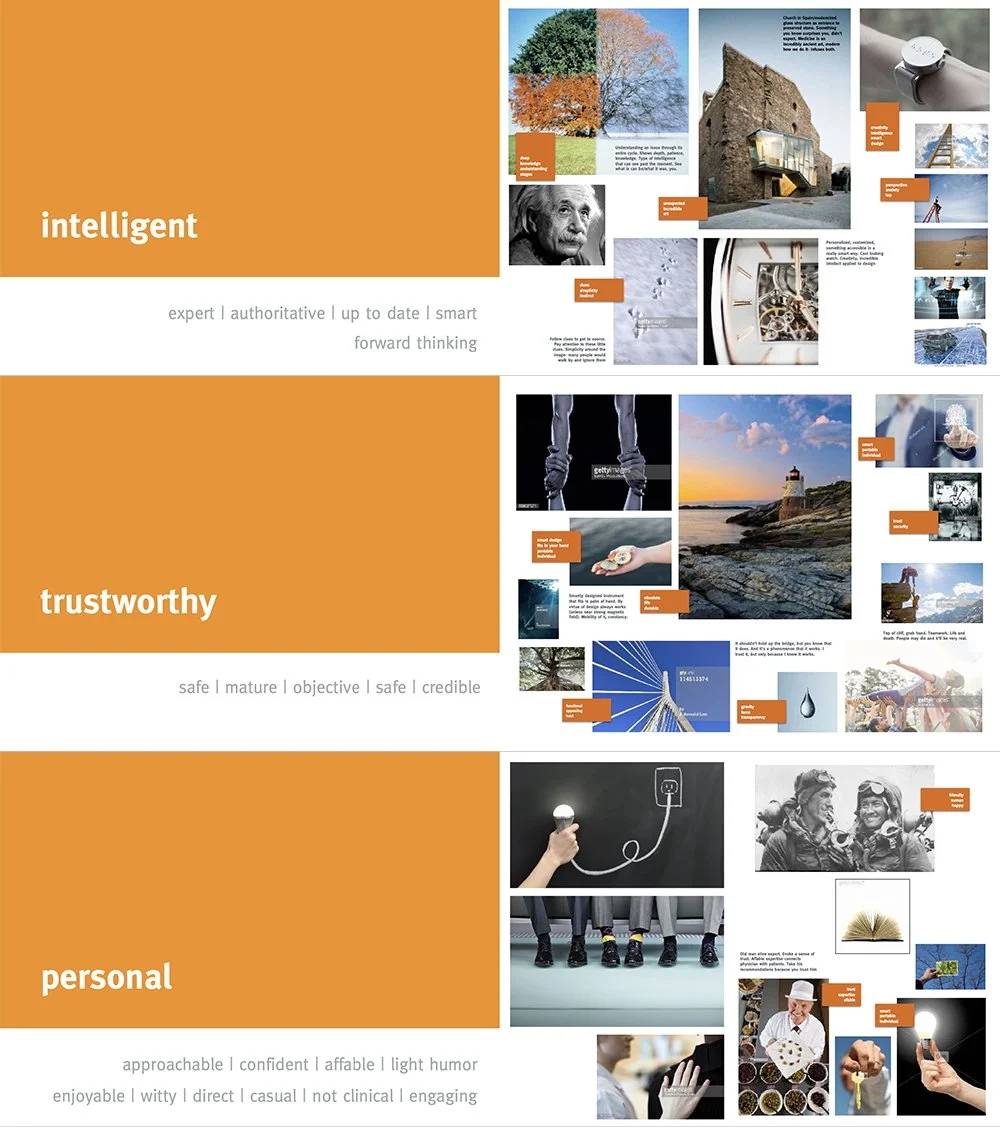
A service can’t deliver on a brand promise without a story to measure itself against. I partnered early with our CMO and brought in my former colleagues at the design studio analogous to run an executive workshop on what was unique to 98point6. The result was Continuity Care: the belief that technology could provide consistent, smarter, empathetic, lifelong care on the patient’s terms, by listening to and learning from every encounter.
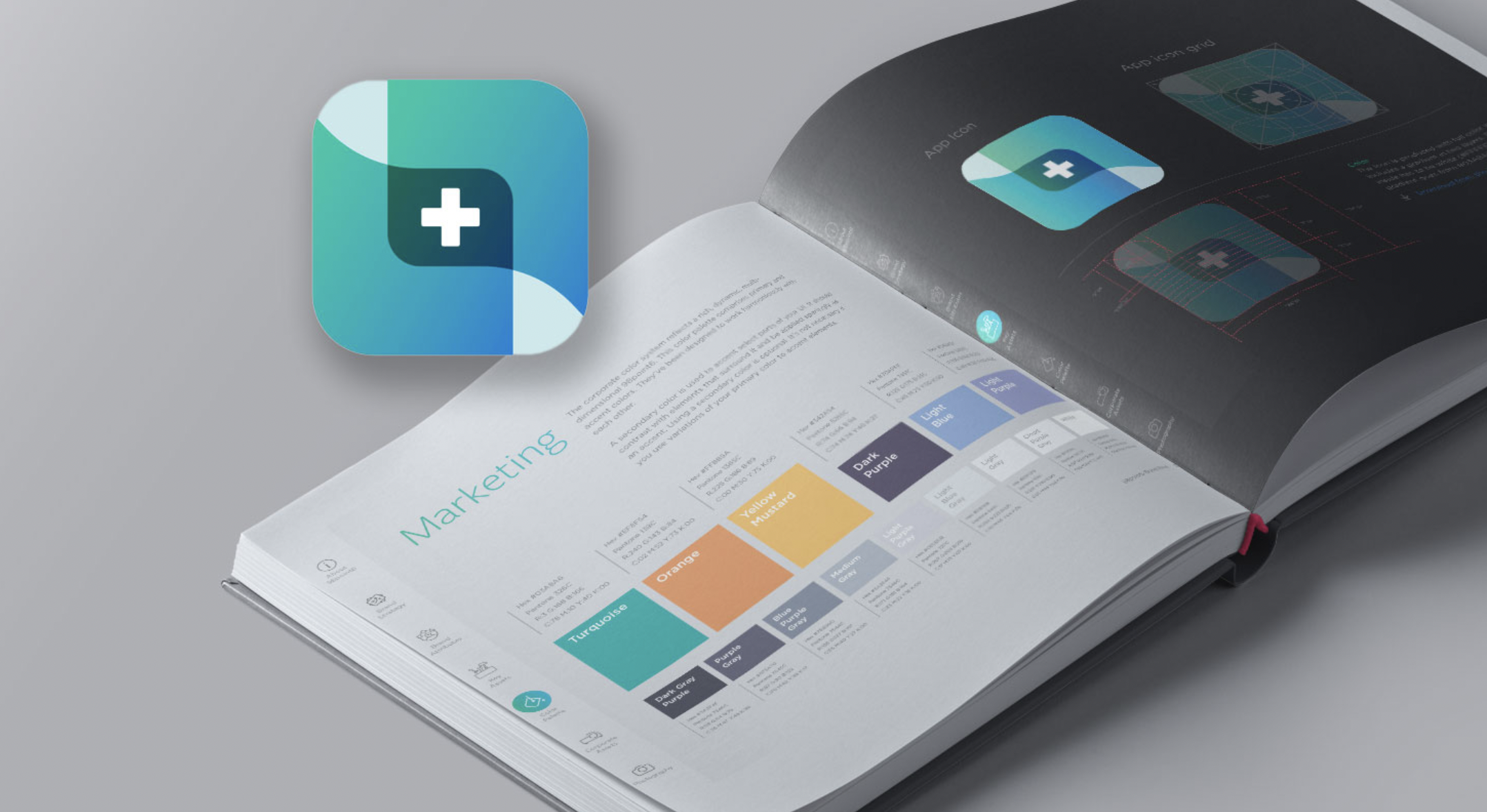
A few months later we reconvened to define the brand mark, app icon, tone, and visual language. My team used all of it to keep the product consistent with the brand and with communication design as both evolved.
Test whether people would trust a bot with their health
The company’s hypothesis was that the more of a text visit we automated, through natural language processing and AI-selected questions and responses, the more patients each clinician could care for. That only worked if patients would talk to the bot at all.
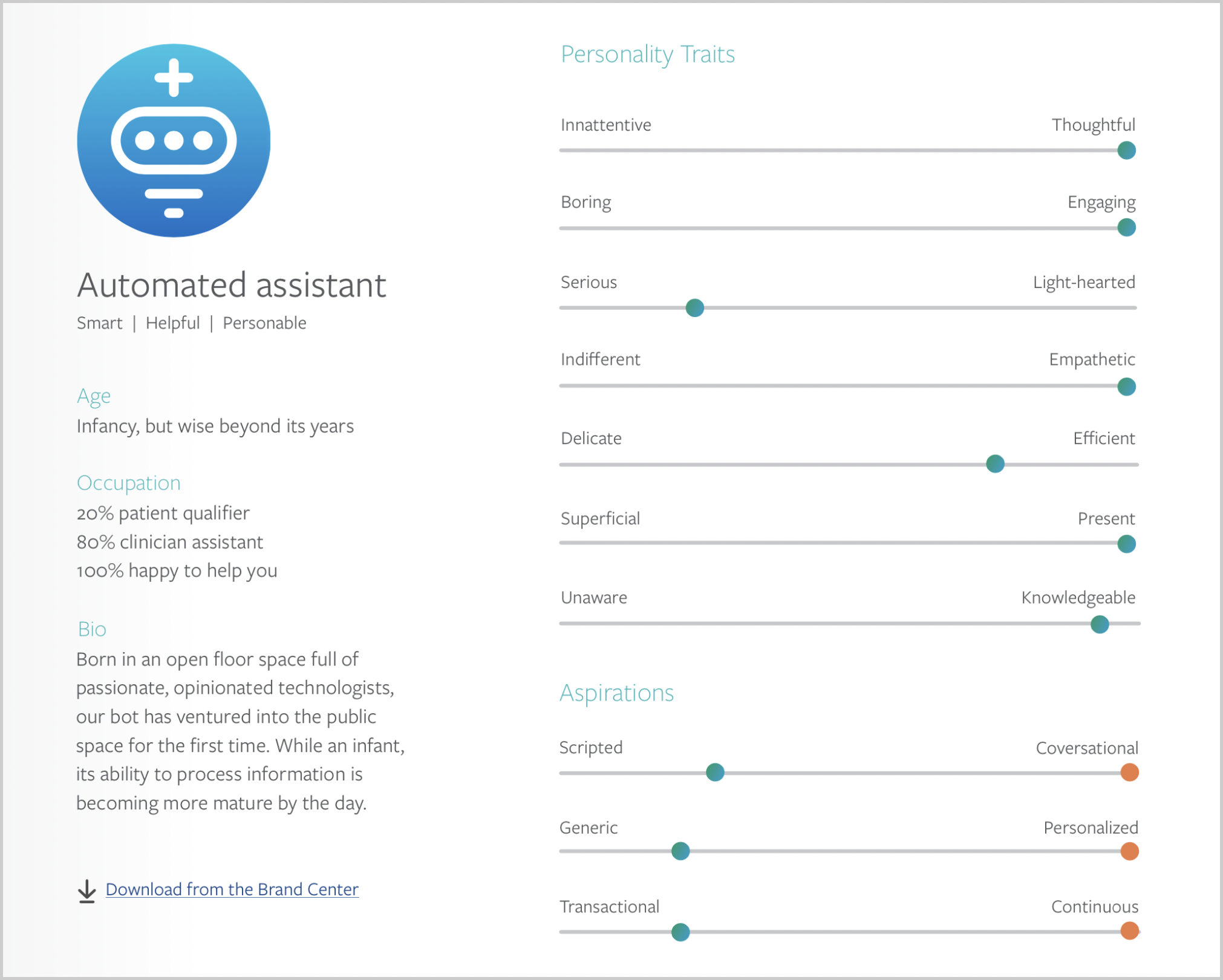
I created a vision framework for the bot’s character, its tone and cadence, and where it would grow over time. It aligned marketing first, and eventually everyone from iOS engineers to product managers to our board of advisors. I wrote the script with conditional logic to move a visit forward or disqualify someone before they became a patient. Once a patient gave their chief complaint, machine learning took over. There was no large language model; the AI was a targeted model that guessed the next question to ask about a patient’s symptoms, drawing on what doctors had asked patients with similar complaints.
I built the first “intro bot” prototype on an open-source SMS platform while my designer and researcher ran formative research. People were comfortable onboarding and answering symptom questions from the bot. We shipped the first patient experience on iOS, Android, and the web in four months.
The model raised a question data science hadn’t answered: how many of its questions would a patient answer before giving up? Data science had set loose thresholds for the quality and number of questions allowed. We tested it, and engagement began to fall off at around seven. That finding changed the model work. To get better signal from fewer questions, data science trained more chief complaints with more people, raising the quality of each question the bot asked.
Give the bot an interface of its own
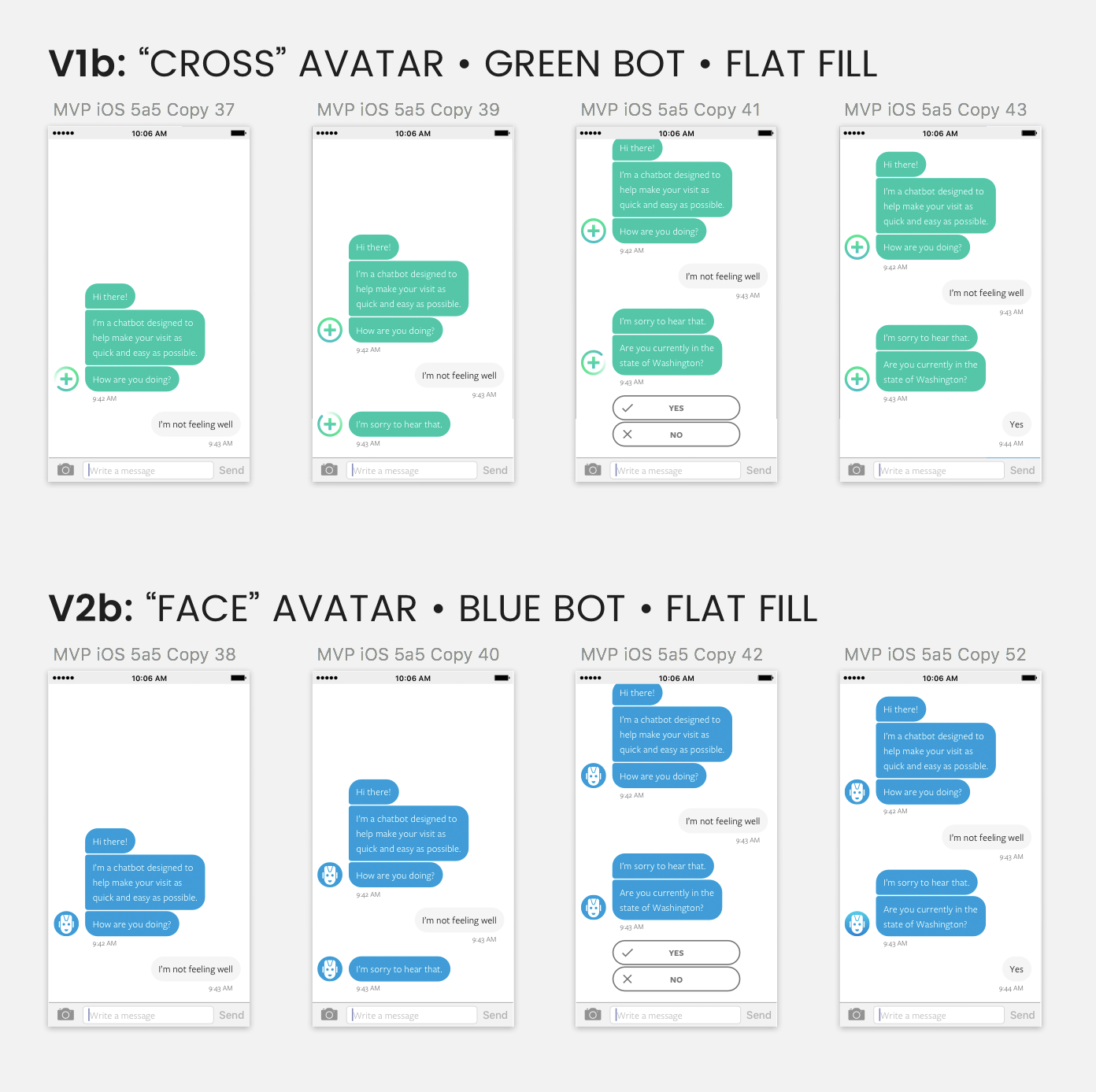
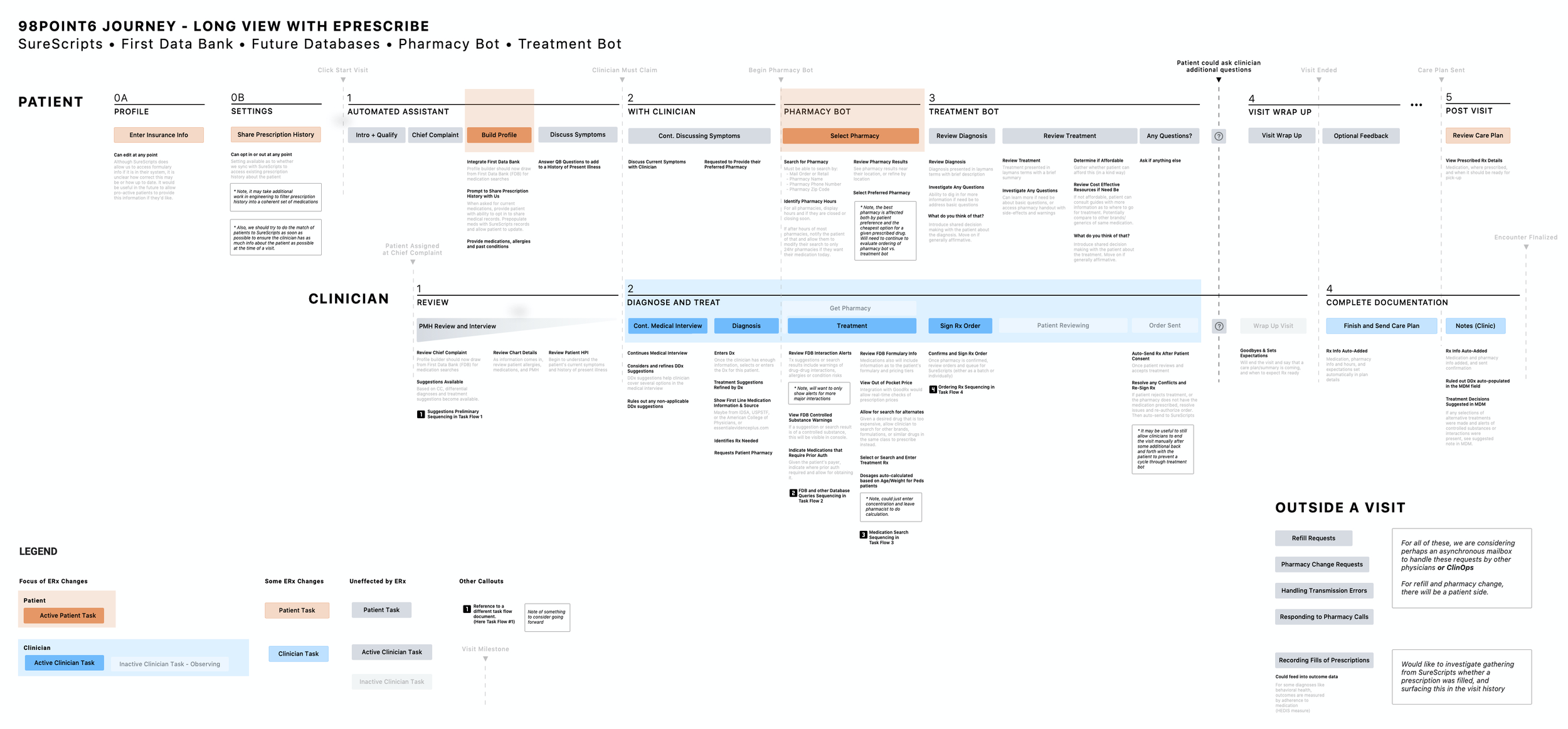
The first release lived in a standard SMS-style thread, and for a while that was the point: texting a doctor felt as familiar as texting anyone else. But a column of speech bubbles offers one gesture, which is to reply, and care asks for more. A doctor needs to see the rash. A patient needs to pick a pharmacy, confirm an allergy, and find tomorrow the care plan they were given today. Every capability we wanted to give the bot had nowhere to live except another line of text, and the standard SMS interface began to limit what we could build.
So we went back to the interaction model itself. Instead of treating the visit as a transcript, we treated it as a conversation that could hand the patient what the moment called for, like a camera or a set of choices. We explored it through three lenses: extensibility, so new clinical services could arrive without a redesign; visual simplicity, so someone who felt unwell on a small screen could still find their way; and accessibility, so the visit worked for people who are deaf or hard of hearing, blind or low vision. The bar was a conversation as natural as talking to your doctor, with affordances a chat window never had.
That work became the Hammond design system: the shared language for every interface that followed, from the patient app to the clinician’s console.
Extend the bot beyond the visit
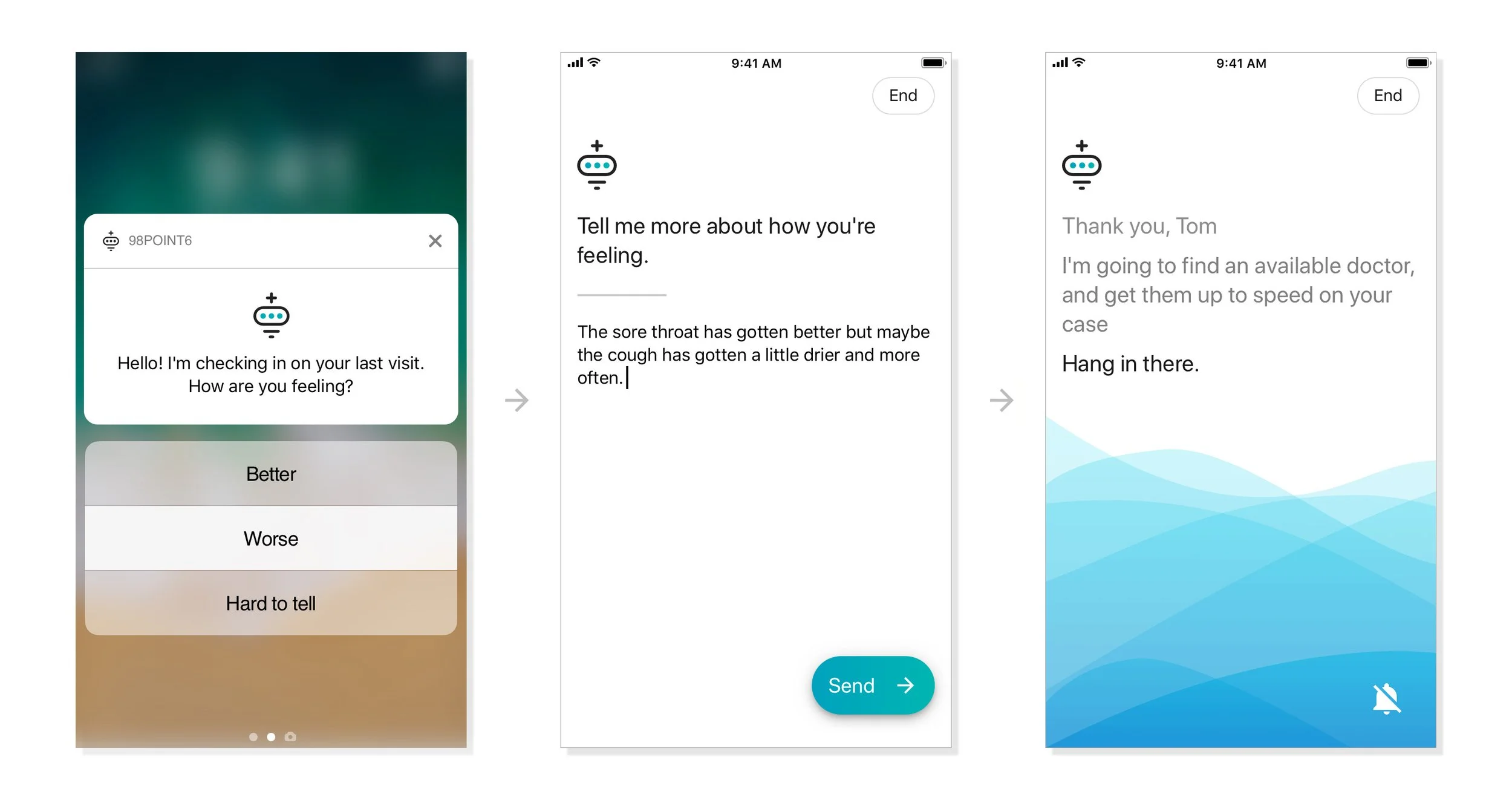
Continuity Care meant moving past the episodic relationship people have with primary care. With Hammond in place, Auto Follow-ups became the initiative that put the north star into practice. The bot reached out after a visit through smart push notifications, asking how the patient was feeling and bringing a doctor back in when they needed one, so care continued after the visit.
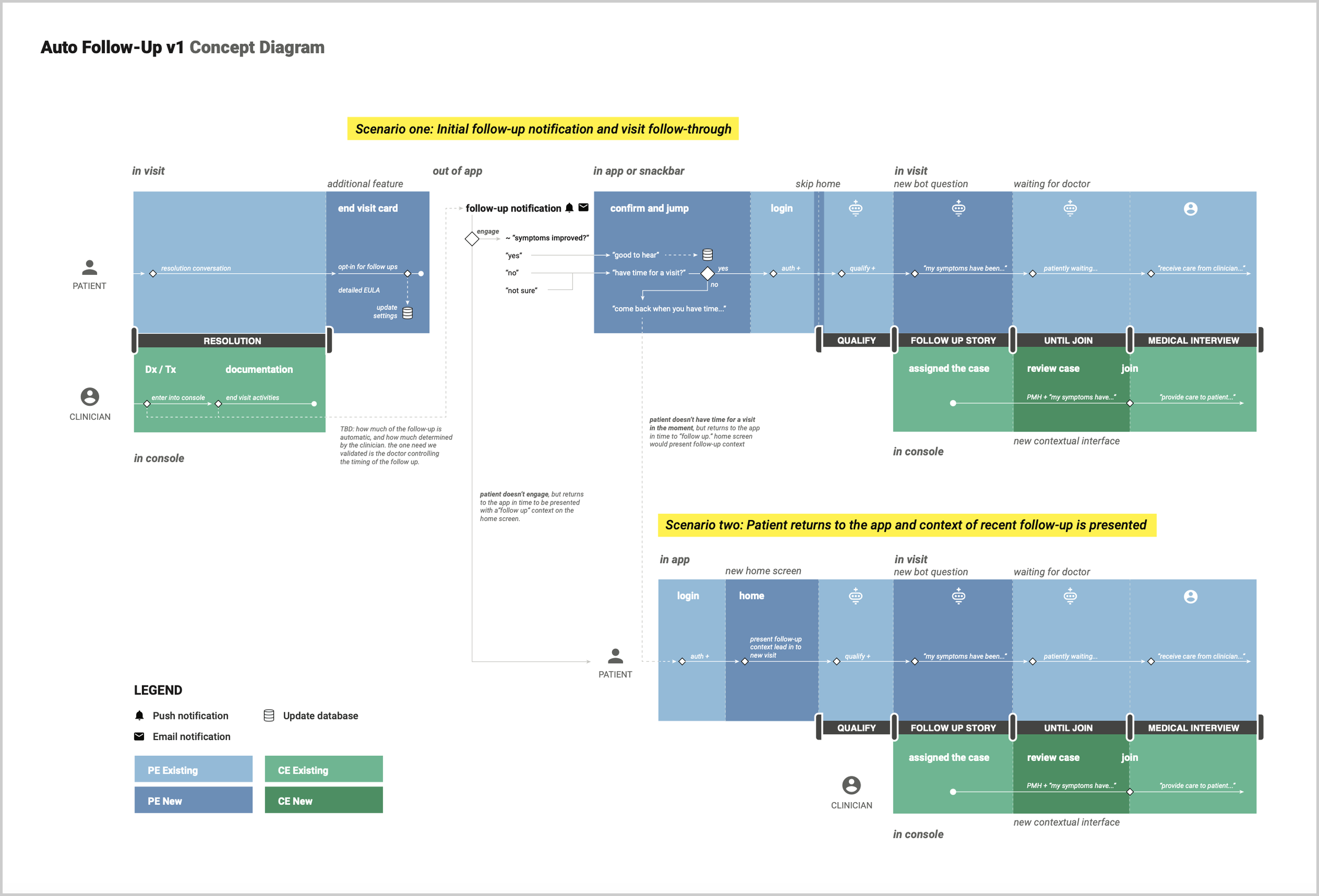
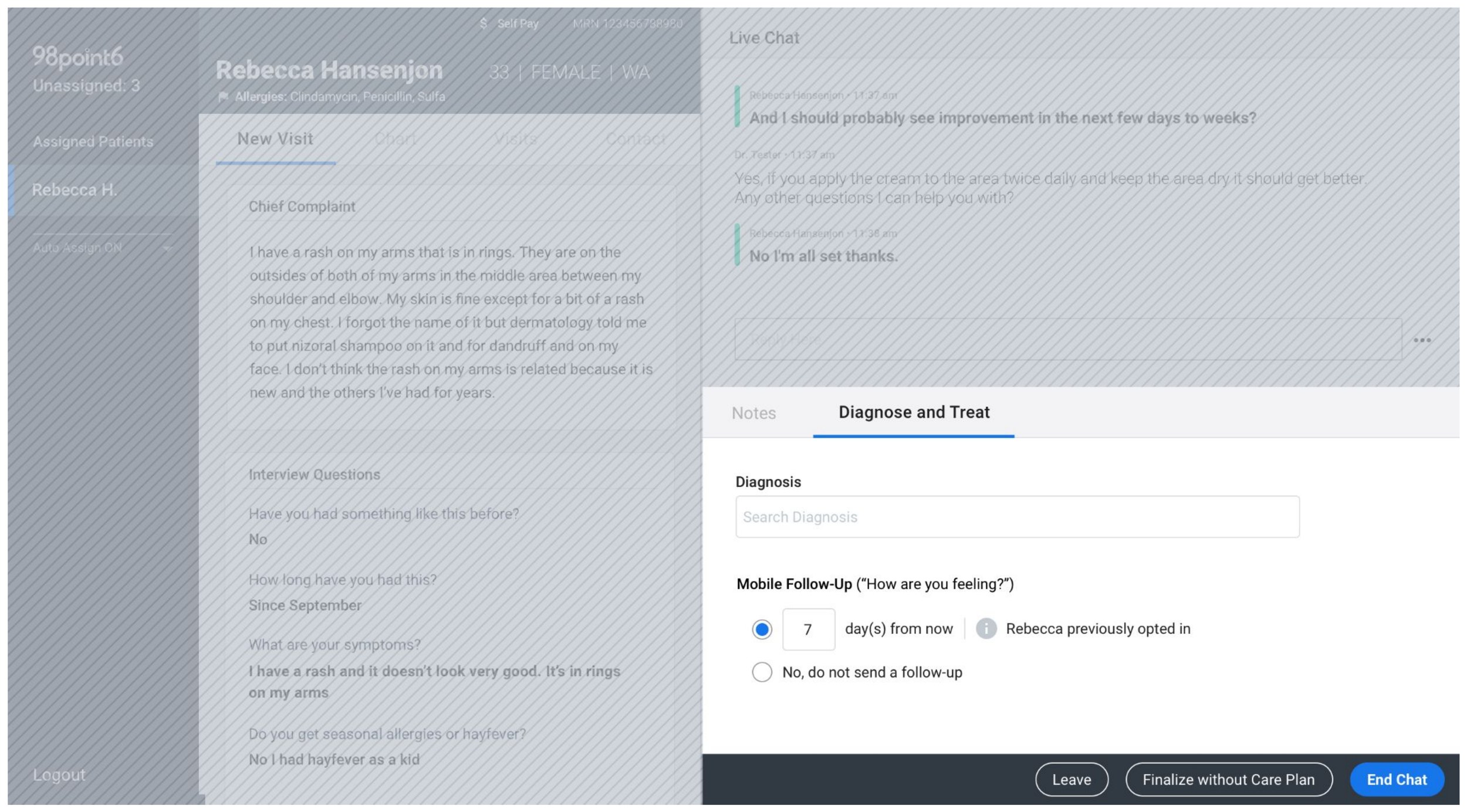
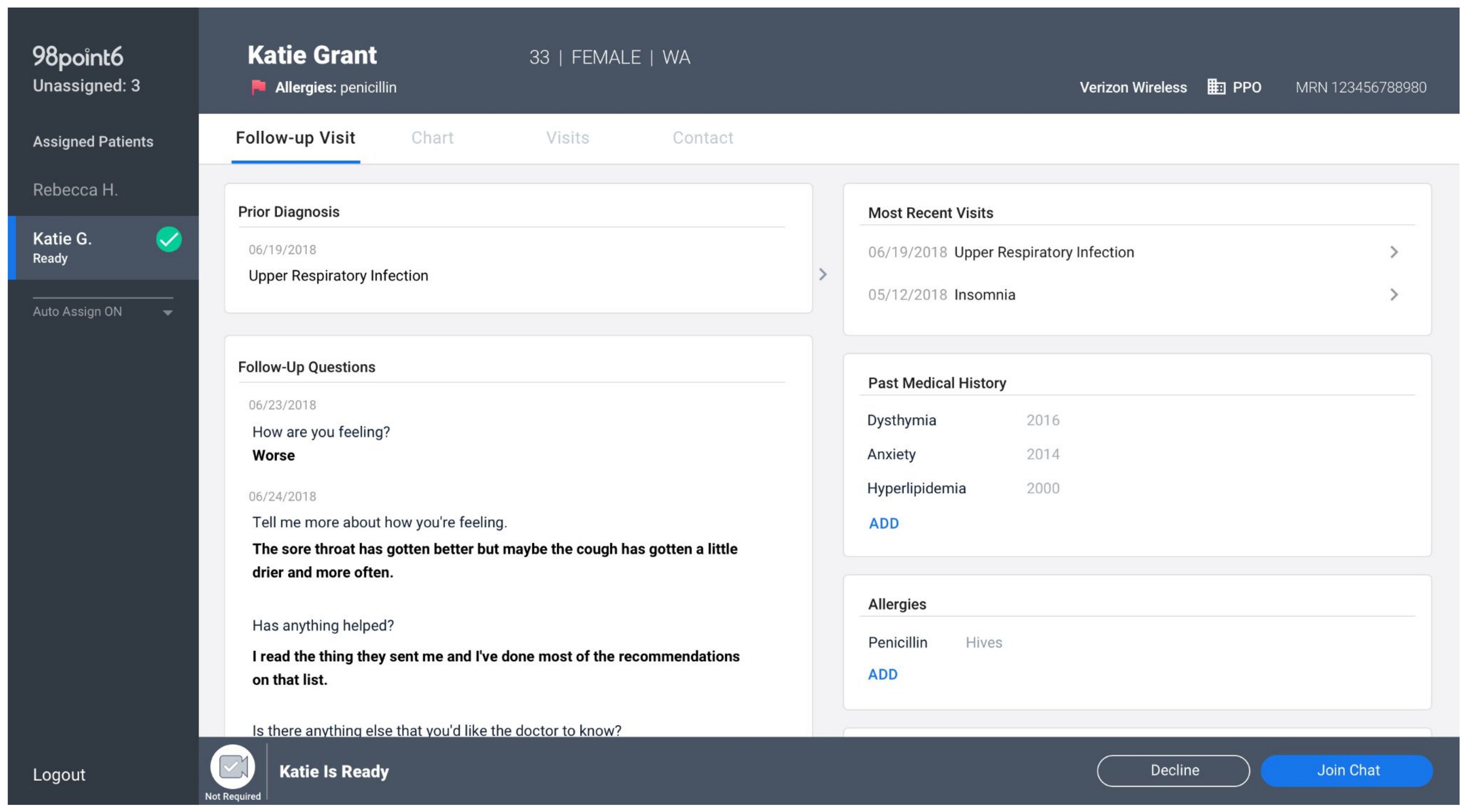
On the clinician’s side, the follow-up became part of the care plan. The doctor scheduled the check-in before ending the visit, and the patient’s answers came back to the console as a follow-up visit, with the prior diagnosis and history beside them.
Follow-ups also closed a gap in what the model could learn. Until then it saw what happened during a visit, never what happened after. Each “Better,” “Worse,” or “Hard to tell” was a signal about whether a diagnosis and treatment had worked. That data would only pay off at scale, so we built the flow to capture it from the first visit.
Keep the clinician in the loop
In year two we invested deeply in the clinician console. The work ran from integrating with the electronic medical record to automating SOAP notes, presenting an AI-generated differential diagnosis, and adding a seamless prescription service. The aim was clinician efficiency without trading away quality of care: the model narrowed the possibilities, and the doctor made the call.
We met data science at the points where the model met people: which questions the bot asked after a chief complaint, how the patient’s answers were framed for clinicians, and what a follow-up should capture.
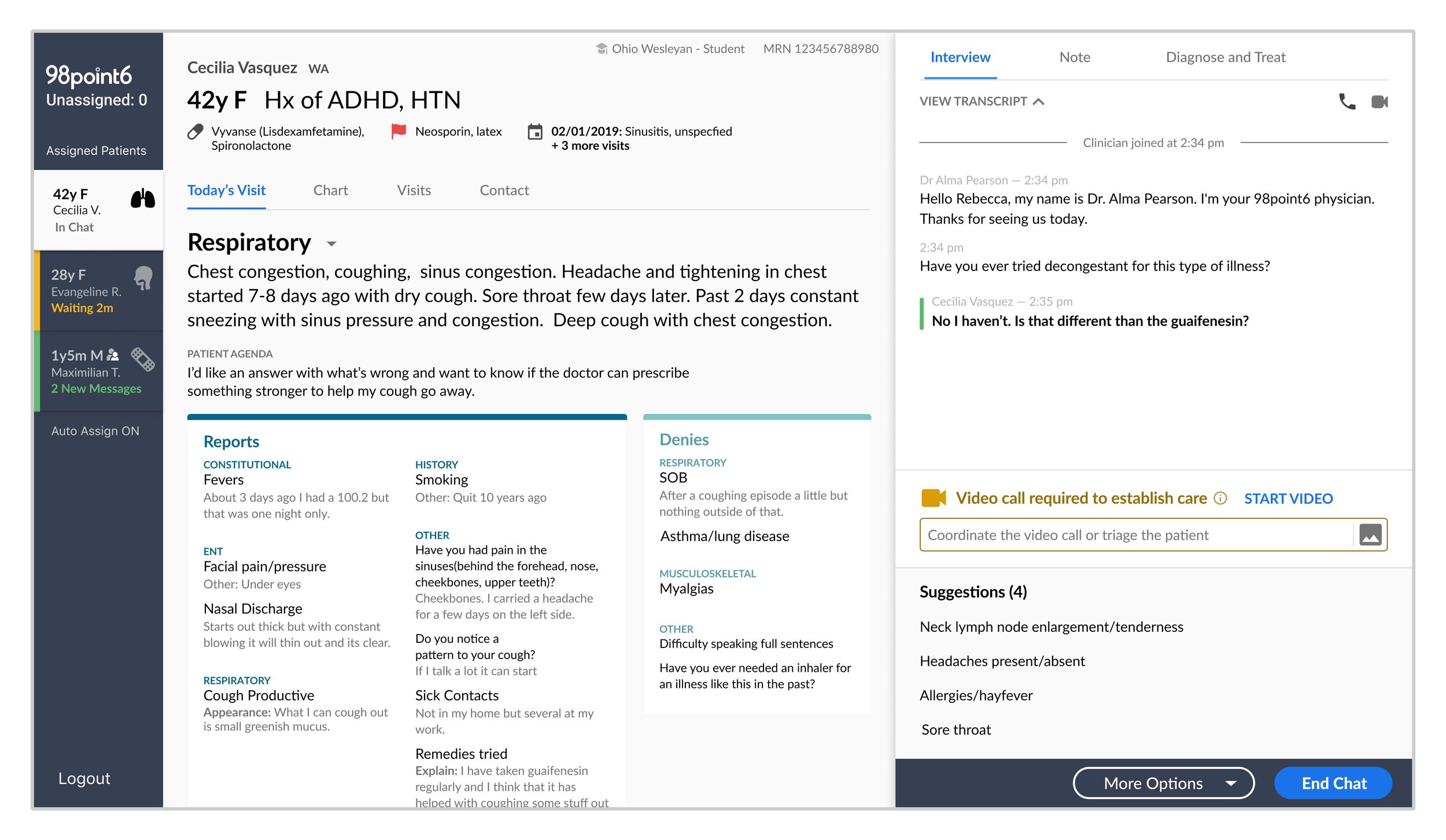
The differential depended on how we exposed what the patient had said. Doctors build a differential from pertinent positives and pertinent negatives: the symptoms that support a diagnosis, and the expected ones that are absent. So the console didn’t hand clinicians a transcript. It sorted the bot’s intake by body system into what the patient reported and what they denied, the frame a physician already reasons in, with the patient’s own description and agenda at the top.
Clinicians were given prewritten responses to speed up the chat, and they typed their own anyway. They understood the business model and still chose patient care first, even in nuanced, low-risk moments. Automation had to earn its place in the conversation.
Track two
Building the practice
Grow the team in step with the product, agree on how we would work, and hold the lines that matter in healthcare.
Grow the team around shared tenets
I hired in step with the product. For the first release, I brought on two product designers, a UX researcher with a PhD in social psychology, and a contract designer. About a year in, as the console work grew, I hired a director to lead a dedicated Clinic UX team, along with three more senior product designers and a senior UX researcher with a PhD and experience testing design experiments with role-based users. Just before I left, I hired a director to lead the Member UX team and take over my role.
As a Product & Design organization, we valued making the right things for our customers, and then validating that we were making those things right for our users—from patients to buyers to clinicians.
I co-designed our operating tenets with the Member (patient) & Clinic (clinician) UX teams once I had a grasp on the complexity of our ecosystem, the agency we held as a function, the investment the business was willing to make in research, and the role each person could play in delivering value.
-

Frame It to Make It
We believe that the work to investigate, frame, and pursue the outcomes that serve the people who use our product is the kindling that sparks innovation. Empathizing with users is critical for feeding ideation, and framing such insights points us in the right direction. We do not get paid to do the wrong things right.
-
Everything is a Prototype
We approach our day-to-day to improve how we deliver value. Impactful experiences don’t come easy; they begin messy and ambiguous. We put forth ideas, have conversations, make artifacts, observe dynamics, and rapidly iterate to advance forward. We’re precious when we refine, not when we mine.
-
Data Are Our Friends
We synthesize data as numbers by investigating the context of data as stories (and vice-versa). We socialize our hypotheses, transforming information into knowledge, and lean on each other to gain collective wisdom. Data shapes our approach, and we align deeply to make the proper bets to move forward.
-

All the Things, Intentionally
We engage with intent, from meetings to sketching to interacting with peers. We understand that our approach to work models best practices for those with less experience. This takes concentrated effort, and we know that nothing worthwhile is ever easy, especially within challenging and ambiguous ecosystems.
-

Friction as Necessary
We are gracious partners, share learnings, and believe value is born through healthy discourse. We dig in deep within difficult conversations, always providing grace. We exemplify courage by asking pointed questions, which may slow progress. We’re commit to explore value across a multitude of human-centered dimensions.
-

Multilingual Modus Operandi
We actively listen as we investigate the intersection of people, technology, and business. We speak multiple languages to understand diverse organizational drivers while negotiating trade-offs, ensuring short-term value as we steer towards long-term effectiveness. We inform the business, as we too are the business.
-

Range of Scenery
We leave our comfort zone, and ask open ended questions. We observe behavior so that we can design our service to deliver value for real people. We look for cues that spark our next “aha!” moment. As novel mental models become apparent, we lean in, prototype, and test our hypotheses.
-

Scaling Expectations
We operationalize for effectiveness as the company grows. Our commitment to deliver human-centered value remains unwavering AND we recognize the importance of aligning with business strategy that unlock scale. As a design function, we support each and every stage of the journey.
Test ideas before a line of code
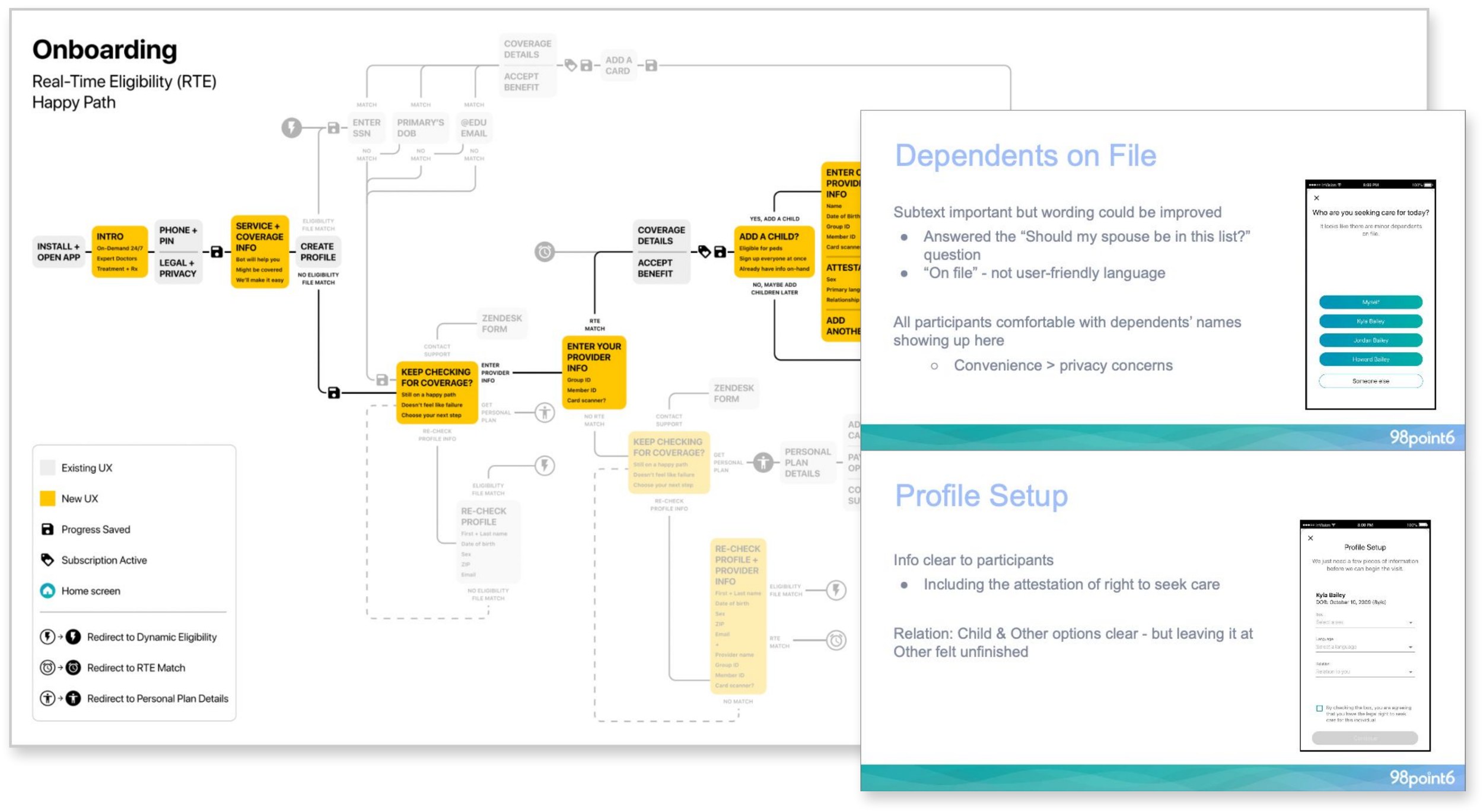
Formative research had shaped the product since the first bot prototype. As the team grew, I formalized it into a framework every team could run on its own: plan, prototype and recruit, test, synthesize, share results, and hold a retro, with clear owners across product, design, research, and UX engineering at each step.
Its premise fit the stakes. When a team had a hypothesis, quick qualitative sessions with a prototype answered it before we committed to an expensive build and deployment cycle. And where we were already confident in our patterns, we tested only the parts we weren’t sure of: a task flow, a line of copy, an affordance.
Hold the line where care, compliance, and the business met
In healthcare, design decisions carry obligations beyond usability. I set up a compliance process with product, marketing, and legal: anything that changed what patients could see needed both a marketing and a legal review before it shipped. HIPAA set the stakes. It was explicit in places and open to interpretation in others, so legal always had an opinion, and we showed them the work. Some calls were made once and built in, like having the bot ask what state a patient was physically in, so every visit complied with the law. Once it was running, I took my own work through it and coached my team through theirs.
Some lines were ethical rather than regulatory. I wasn’t comfortable putting the PHQ-9, a standard depression screener, into the conversation for the bot to present unmodified; it went in as is. And when leadership considered removing the doctor’s avatar so the bot would appear to run the whole visit, I argued to keep it, and it stayed. Patients deserved to know when a physician was caring for them.
Intake didn’t always give clinicians enough symptom detail, and going back to the patient slowed the visit. I pushed data science and the executive team for an expert system: rules-based follow-up questions to close that gap now. Leadership chose to have the model learn to handle it instead, a longer-term bet on the company’s value. It was a fair trade-off, and one of many where patient care, efficiency, and valuation crossed in ways design had to hold together.
In their words
“Sean used his years of experience to lay the groundwork for future growth. He carefully chose where to spend his time for the most impact and established relationships that would be needed when his team was bigger. He hired many designers and researchers, set out core practices, and defined the role of UX within other disciplines. He pushed whole teams to consider the long view on projects. He was uniquely focused on relentlessly improving how the entire product team worked, made decisions, and delivered human impact by introducing processes, principles, and artifacts.”
“Sean is a strong design leader, advocate, and mentor. He succeeded in building a thriving design practice from the ground up. Not only does he have strong design skills, but he presents his ideas with the persuasiveness necessary to get broader teams and leadership onboard. He thinks critically about problems, provides valuable analysis and suggestions in critique, and provided clear design direction for our team. As one of his former direct reports, I can attest to his mentorship skills and always appreciated his guidance and constructive feedback.”
Key learnings
- A polished chassis needs a killer engine.Design could make a narrow model feel trustworthy and personal, and every improvement to the experience raised what patients expected from the intelligence behind it. Our machine learning was solid, but we left a lot on the table, from the question ceiling to the symptom detail clinicians still had to chase. I’d pair each experience bet with an explicit ask of data science: what the model has to do for this experience to keep its promise.
- Bring patient research upstream of the model.The question ceiling we found changed the model work, but it arrived after data science had set its thresholds, because we met at checkpoints rather than working together. I’d put patient research into model decisions from the start, with design and data science working toward shared outcomes instead of handoffs.
- Design for the clinicians you have, not the ones the model assumes.Clinicians’ own replies and individual styles slowed automation, and they were right to put care first. Earlier, I’d have designed for that variation directly: support clinicians as they practiced while training the model toward specific points of automation. In medicine, quality is everything and the data are small; pacing autonomy is both pragmatic and ethical.
- Give design’s impact a signal of its own.We moved fast and with care, and judged the work through qualitative research and app ratings. My CPO felt more metrics would add noise, and at that pace it was a reasonable call. But it left design’s contribution to be read through product-level results. I’d keep a few light, design-owned signals, like time per visit and follow-up response rates, so the team could see the effect of its own decisions without slowing down.
- Scale through your leaders, not around them.As the team grew and I brought on directors, I had to rely on my managers and their talent rather than stay as close to the work as I wanted. What I could still shape was how the team thought: I coached them toward artifacts that moved the next conversation, a journey map for stakeholders or a no-code prototype for engineers, and away from polish for its own sake. Letting go of the craft was part of the job.
Questions about this project? Email me.